Efficiency Meets Force

We design, build, and produce electropermanent magnet systems — from custom magnetic circuits and driver electronics to volume manufacturing. Over one million magnets delivered.

The Advantages of Electropermanent Magnets

EPMs offer a unique combination of properties that make them ideal for demanding industrial and robotics applications.

Zero Holding Power

EPMs maintain their magnetic state without any electrical input. Power is only needed for the brief switching pulse, dramatically reducing energy consumption.

🔒

Fail-Safe Operation

Unlike electromagnets, EPMs maintain their grip during power failures. The magnetic state is inherently stable, providing true fail-safe holding in critical applications.

Rapid Switching

State changes occur in milliseconds with a short current pulse. This enables fast pick-and-place cycles and dynamic clamping operations without thermal buildup.

🌡

No Heat Generation

With no continuous current flow, EPMs produce virtually no waste heat during holding. This is critical for temperature-sensitive processes and confined spaces.

🔧

Compact & Robust

Without the need for large coils and cooling systems, EPM assemblies can be significantly more compact than equivalent electromagnet systems.

📈

Controllable Force

By varying the switching pulse parameters, the holding force of an EPM can be precisely controlled, allowing for adjustable grip strength in a single device.

Built for Real-World Demands

Our EPM designs achieve exceptional force-to-weight ratios, backed by over a million units in production.

218–480:1
Adhesion-to-Weight (kgf/kg)
1M+
Magnets Produced
g → kg
Scale Range
USA + Asia
Production Capability

What This Means for Climbing Robots

A 10 kg inspection robot needs reliable adhesion to traverse vertical steel walls and inverted surfaces. With our 218:1 ratio EPMs, just 46 grams of EPM per foot provides enough force to hold the entire robot — leaving massive safety margin for coatings, air gaps, and dynamic loads. Even on painted or coated steel (which can reduce holding force by 40-60%), the system maintains robust adhesion with force to spare.

What This Means for Drones

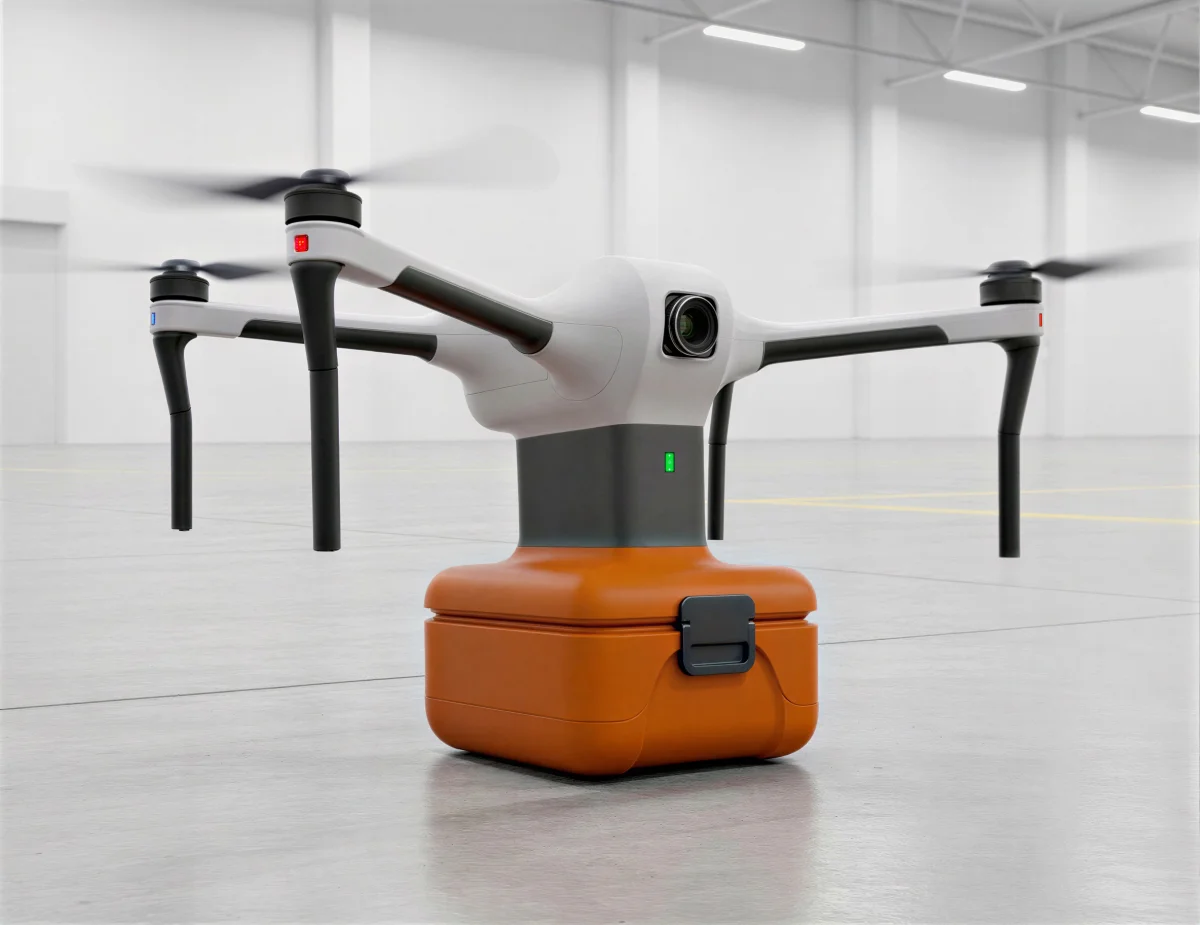
A 25 kg payload drone carrying a 5 kg sensor package needs a gripper that's light, reliable, and draws no power during flight. A single EPM unit weighing 250 grams holds over 54 kg — providing a 10× safety factor on the payload. With our next-gen designs at 480:1, the same unit holds over 120 kg. No moving parts, no continuous power draw, and if the battery dies the payload stays attached.

Substrate & Interface Effects

EPM holding force is highly dependent on the target material. Thicker steel substrates allow more flux to flow, increasing force. But real-world surfaces have paint, coatings, corrosion, and air gaps that space the EPM off the bare steel. We model and test these effects during design — optimizing the magnetic circuit for your actual operating conditions, not just ideal lab scenarios.

How Small Can an EPM Be? — Project Aria

Meta's Project Aria research glasses use tiny electropermanent magnets for modular sensor pod attachment. These EPMs weigh under 1 gram and fit within the temple arms of eyewear — demonstrating that EPM technology scales down to the millimeter level, not just centimeters. When every milligram counts and mechanical latches are too bulky, EPMs provide a solid-state, zero-power attachment that can be released with a brief electrical pulse. This is the extreme end of the "g → kg" scale range we support.

Custom EPM Driver Boards

Every EPM needs a driver. We design custom switching electronics matched to your magnet, your system architecture, and your communication protocol.

Purpose-Built Switching Electronics

Our driver boards deliver precisely controlled high-current pulses to switch EPMs on and off. Each design is tailored to the specific magnet's coil impedance, required pulse energy, and switching speed — not a one-size-fits-all solution.

Boards can drive single EPMs or arrays of independently controlled channels, with built-in diagnostics, current sensing, and thermal protection. Form factors range from thumbnail-sized embedded modules to rack-mount multi-channel controllers.

Any Protocol, Any Interface

We integrate whatever communication interface your system requires. Whether you need a simple digital toggle line from a microcontroller, or full bidirectional control over an industrial bus, we design the driver to fit your architecture — not the other way around.

Supported Protocols

  • Simple digital toggle (GPIO / discrete wires)
  • RS-485 / RS-232 serial
  • USB (CDC, HID, or custom)
  • CAN bus (CANopen, custom)
  • Bluetooth (BLE)
  • Wi-Fi (TCP/UDP, MQTT, HTTP)
  • GPIB (IEEE 488) for lab & test environments

Driver Features

  • Precision pulse energy control
  • Multi-channel independent switching
  • Current sensing & state verification
  • Overvoltage & thermal protection
  • Compact embedded or rack-mount form factors
  • Custom firmware for application-specific logic

How EPMs Are Controlled

A brief pulse from the driver switches the EPM between ON and OFF states. No continuous power is needed to maintain either state.

EPM driver system block diagram showing EPM module, H-bridge driver with onboard microcontroller, power supply, and host controller

How Electropermanent Magnets Work

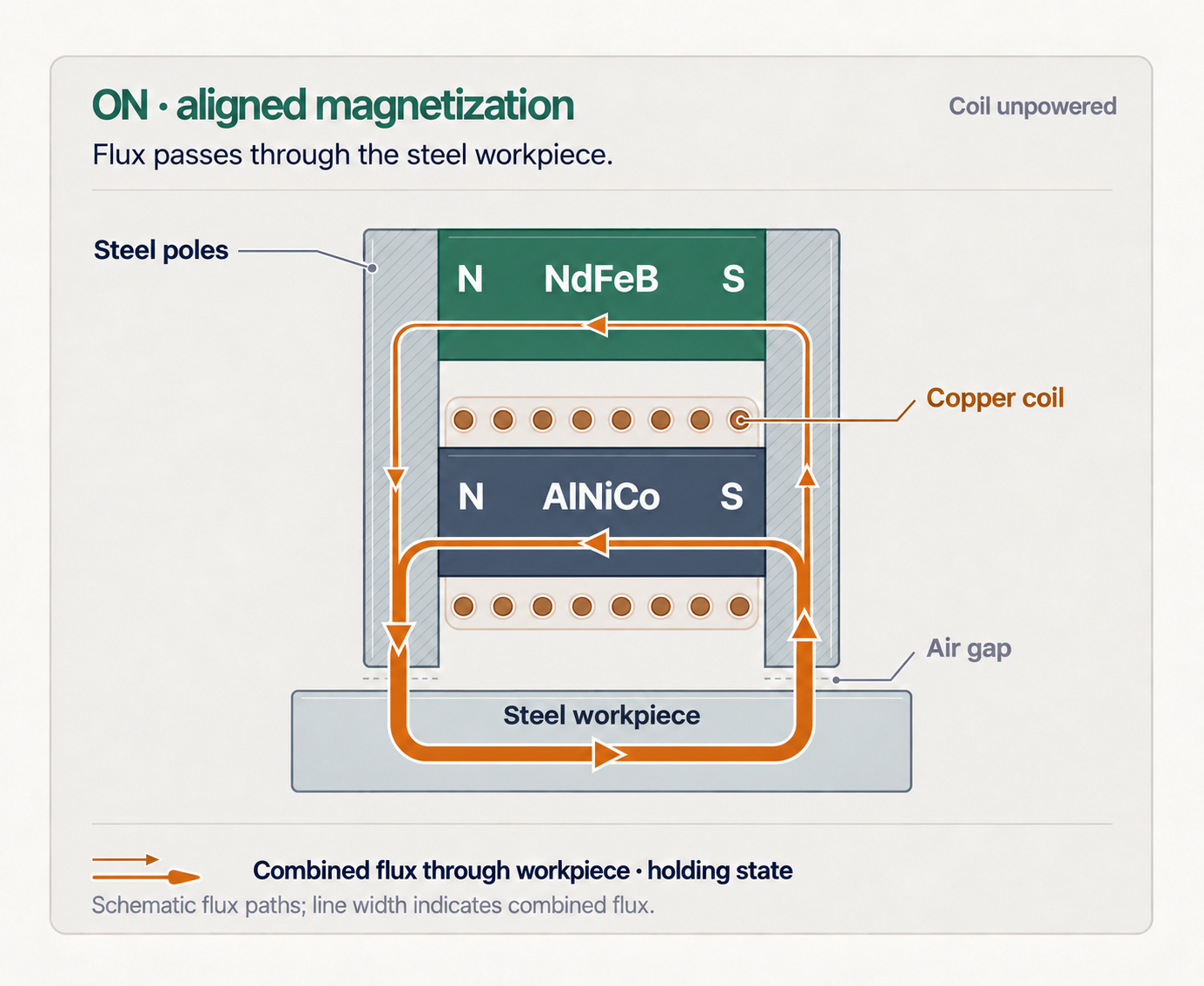
An EPM consists of two magnetic materials wrapped by a coil. A hard magnet (like NdFeB) has high coercivity and maintains its magnetization. A semi-hard magnet (like AlNiCo) can be remagnetized with a relatively small current pulse.

When both magnets are aligned (same polarity), their fields combine and strong flux flows through the external workpiece — the ON state. When the semi-hard magnet is reversed by a current pulse, the fields cancel internally and minimal flux reaches the workpiece — the OFF state.

Read the full technical overview →

Electropermanent magnet cross-section diagram showing NdFeB hard magnet and AlNiCo semi-hard magnet with coil and pole pieces in ON state

Where EPMs Excel

Electropermanent magnets are deployed across a growing range of industries — from drone payloads to space docking to factory floors.

🛫

UAV Payload Systems

Solid-state payload attachment and release for drones — zero power during flight, fail-safe hold, no moving parts.

🚀

Space & Aerospace

Spacecraft docking, payload separation, deployable structure latches, and CubeSat interconnects.

🤖

Climbing & Inspection Robots

Switchable magnetic adhesion for robots inspecting ship hulls, bridges, tanks, and pipelines.

🌊

Underwater Systems

ROV station-keeping, AUV docking, and subsea tool attachment on ferromagnetic structures.

🧮

Modular Robotics

Self-assembling and reconfigurable robot modules using EPMs for switchable, zero-power connections.

CNC & Industrial

Workholding chucks, heavy lifting magnets, mold clamping, robotic grippers, and magnetic brakes.

View All Applications →

Ready to Integrate EPM Technology?

Whether you're exploring feasibility or ready to deploy, our team can guide your EPM project from concept to production.

Get in Touch