
Engineering
EPM Engineering & Design
From FEA-driven magnetic circuit optimization and driver electronics architecture to precision material sourcing and critical design considerations — the engineering behind reliable EPM systems.
Material Quality
Why Material Sourcing Matters
Not all AlNiCo is created equal. Through extensive vetting of magnetic material suppliers worldwide, we've found that the same nominal grade from different suppliers can exhibit deviations of 20% or more in key magnetic properties — coercivity, remanence, and energy product.
In a conventional permanent magnet application, a 20% deviation might be acceptable. In an EPM, it can mean the difference between reliable switching and a magnet that fails to fully reverse — or one that demagnetizes prematurely.
AlNiCo is cast (or sintered) in the presence of a strong magnetizing field during cooling to align its grain structure. The material is then ground to precise flatness and dimensional tolerances. This is a specialized metallurgical process — AlNiCo is now an obscure material that cannot be purchased from consumer magnet suppliers like K&J Magnetics. Every order is cast to specification and processed to the exact shape and flatness required, making DIY EPM construction extremely difficult.
NdFeB, by contrast, is a commodity mass-produced magnet material readily available from many sources — though for EPM applications we still custom-specify the grade, dimensions, magnetization direction, and surface flatness to ensure proper magnetic circuit performance.
Precision processing of the semi-hard material and careful pairing with the neodymium magnet is something we specialize in. We characterize incoming material batches, match components to ensure consistent switching behavior, and maintain qualified supplier relationships built over more than a million production units.
What Can Vary Between Suppliers
- Coercivity (Hc) — determines switching threshold
- Remanence (Br) — determines maximum flux output
- Squareness ratio — affects switching completeness
- Grain structure and orientation consistency
- Dimensional tolerances and surface finish
- Lot-to-lot consistency within the same supplier
Our Approach
- Incoming material characterization on every batch
- Qualified supplier network built over 1M+ magnet assemblies
- NdFeB-to-AlNiCo pairing optimization
- Statistical process control on critical magnetic properties
- Reject and rework procedures for out-of-spec material
Simulation
FEA-Driven Design
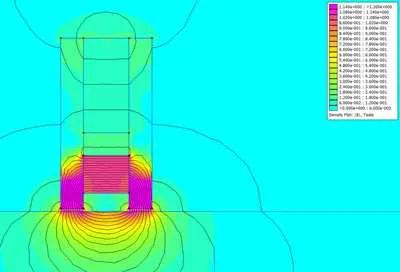
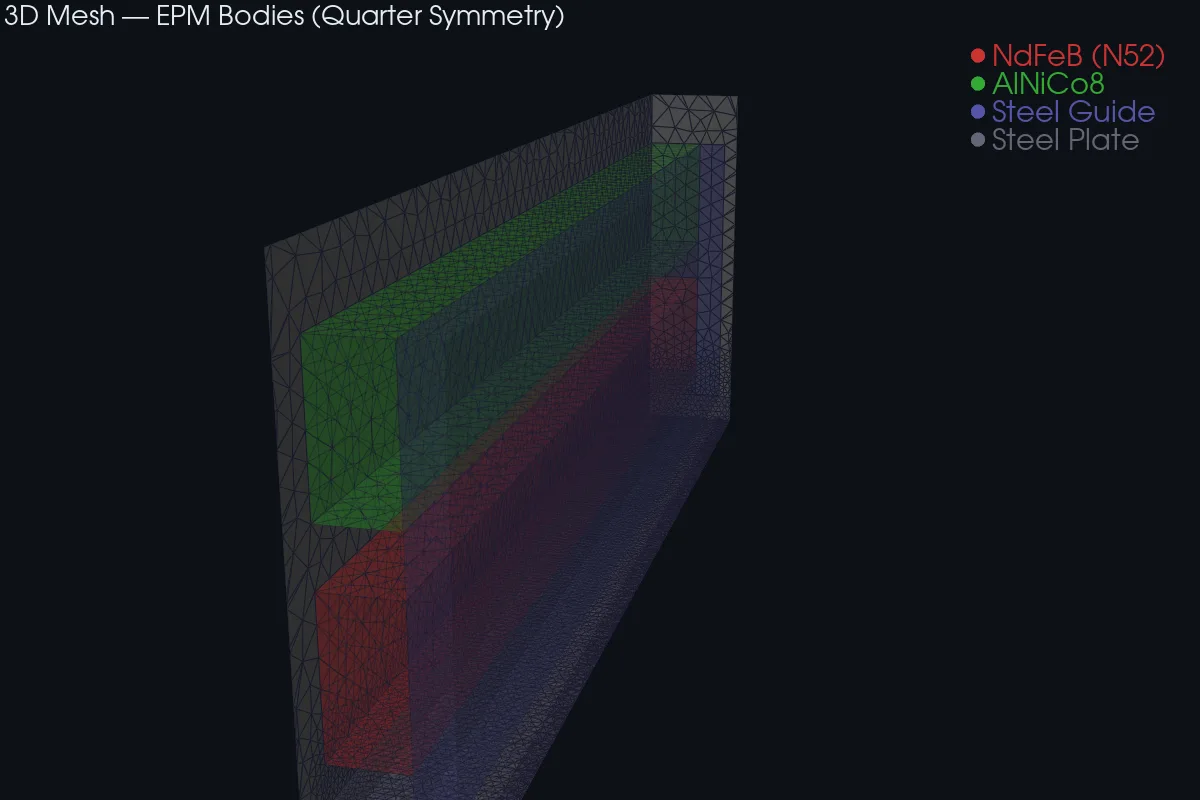
We employ multiple computational electromagnetics (CEM) simulation platforms and validate every EPM design against nearly a dozen independent electromagnetic solvers before fabrication. Our proprietary machine learning optimization algorithms ingest all operating parameters — target force, substrate material and thickness, air gap tolerance, switching speed, thermal envelope, mass budget — and converge on champion EPM configurations that balance material cost, weight, switching energy, and driver complexity.
Our simulation pipeline spans nonlinear magnetostatic analysis, transient eddy-current modeling, coupled thermal-magnetic solvers, and B-H hysteresis loop characterization across the full operating temperature range. We perform parametric sweeps across thousands of geometric and material combinations, applying multi-objective optimization with Pareto frontier analysis to identify designs that no single-variable approach would find.
With extensive empirical correlation data from over a million production units, we maintain tight calibration between our solvers and manufacturing outcomes — enabling us to predict delivered performance within single-digit percentage accuracy before cutting any material.


System Architecture
EPM Driver Electronics
Every EPM requires a driver to deliver the switching pulse. The driver contains a power stage, onboard microcontroller for pulse timing and protection, and a communication interface to your host system.

Switching Pulse Design
Each state change requires a high-energy current pulse — typically in the tens of amperes for 1–10 ms, depending on coil geometry and AlNiCo volume. Single-pulse designs are simpler and lower cost; multi-pulse sequences can improve switching efficiency and enable partial magnetization for proportional force control, but require more sophisticated driver firmware.
Sensing & Feedback
Additional sensors monitoring coil current, voltage transients, or magnetic state can provide real-time validation of adhesion on target surfaces. Status LEDs, digital outputs, or communication bus reporting give operators and host systems confirmation that the EPM has switched correctly — critical for safety-rated applications.
Power Architecture
Boost circuitry is typically used to step up the available system voltage to the level required for efficient switching. The higher the available bus voltage, the smaller and lighter the driver electronics package can be — an important consideration for battery-powered and weight-constrained platforms like UAVs and portable tools.
Engineering
Design Considerations
Building effective EPM systems requires careful attention to several interrelated factors.
Magnetic Circuit Design
The steel pole pieces and return path must be designed to maximize flux through the workpiece in the ON state while providing an efficient internal short circuit in the OFF state. Air gaps must be minimized.
Switching Electronics
The driver circuit must deliver a precisely controlled high-current pulse (often 10–50A for 1–10ms). Pulse energy must be sufficient to fully saturate the AlNiCo while remaining within the thermal limits of the coil and power electronics.
Thermal Management
While holding generates no heat, the switching pulse does create brief heating in the coil. For high-frequency cycling applications, thermal modeling of the coil and magnet assembly is essential.
Material Selection & Sourcing
The AlNiCo grade must be carefully matched to the coil's field capability. NdFeB grade selection involves trade-offs between maximum energy product, temperature rating, and cost.
Surface & Air Gap Effects
EPM holding force is highly sensitive to the air gap between the magnet face and the workpiece. Surface finish, flatness, and material permeability of the target all significantly impact performance.
Scalability
EPMs can be designed from miniature devices (grams of force) to large industrial systems (tons of force). Array configurations allow large-area coverage with independent zone control.
Need Help Designing an EPM System?
Our consulting team can help you select materials, design magnetic circuits, and develop switching electronics for your specific application.
Start a Conversation