
Technology
Understanding Electropermanent Magnets
A technical overview of how EPMs work, the materials involved, and why they offer unique advantages over conventional magnetic systems.
Operating Principle
The Dual-Magnet Architecture

An electropermanent magnet is built around two magnets with different magnetic properties, both enclosed by a switching coil. The key insight is that a brief current pulse can reverse the magnetization of one magnet while leaving the other unchanged.
Hard magnet (high coercivity): Typically neodymium iron boron (NdFeB). This magnet requires an extremely large field to demagnetize, so the switching pulse leaves it unaffected. It acts as the permanent field source.
Semi-hard magnet (medium coercivity): Typically aluminum nickel cobalt (AlNiCo). This magnet can be remagnetized by the moderate field produced by the coil. Its direction is toggled between aligned and opposed to the hard magnet.
Switching coil: A short, high-current pulse through the coil generates enough field to flip the AlNiCo but not enough to affect the NdFeB. Once the pulse ends, both magnets hold their state indefinitely with no power.
Magnetic States
ON State vs. OFF State
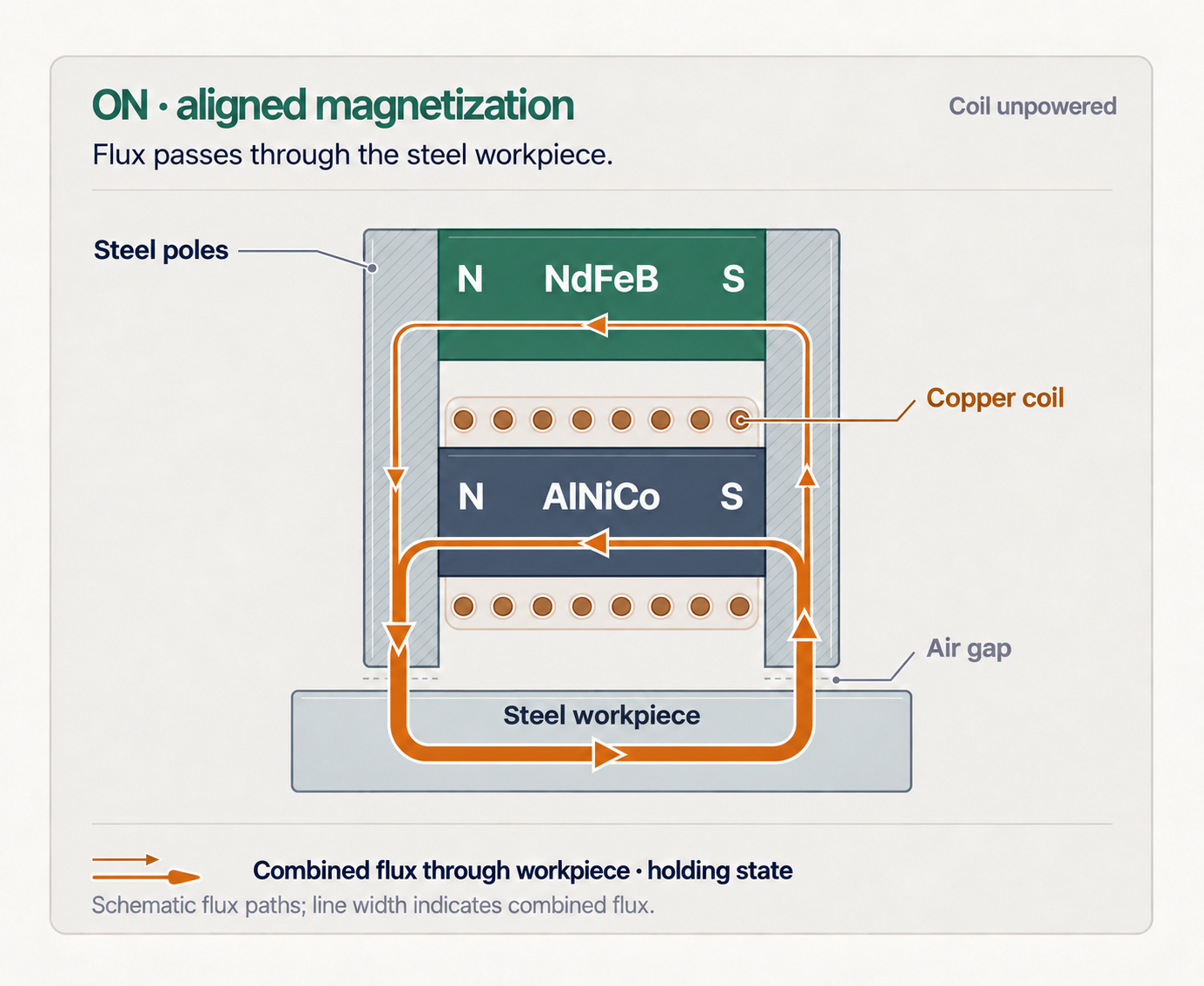
ON State — Fields Aligned
When both magnets are magnetized in the same direction, their fields combine. The magnetic flux is forced out through the external steel circuit (the workpiece), creating a strong holding force. This state persists indefinitely with zero power draw.

OFF State — Fields Opposed
A current pulse reverses the AlNiCo magnet so the two magnets oppose each other. The flux circulates internally between the two magnets rather than passing through the workpiece. The external holding force drops to near zero — again with no power needed.
Switching Physics
How the AlNiCo Flips
A brief coil pulse can reverse the AlNiCo’s magnetization, which remains after the excitation ends. The representative B–H curve below has a normal coercivity, HcB, of approximately 51 kA/m and a remanence, Br, of 1.25 T. The animation follows illustrative internal-field excursions to ±240 kA/m, returning to zero field at the opposite remanent state. The coil excitation required for reversal depends on the magnet and magnetic circuit.
Both remanence points are stable with zero applied field, which is why EPMs hold their state with no power. By tuning pulse amplitude, the AlNiCo can also be partially reversed — enabling continuously variable force output from a single solid-state device.
The AlNiCo is effectively "reprogrammed" — the switching pulse rotates its magnetic field 180 degrees, or to any angle in between. When both magnets have their N poles aligned (same direction), flux flows through the workpiece — ON state. When the AlNiCo is reversed so N meets S internally, the flux short-circuits inside the assembly — OFF state.
Depending on the coil configuration, the switching coil may wrap only the AlNiCo element, or both magnets may have dedicated coils for finer control over the switching process.
Precision Force Control
Proportional Output — Unlike Anything Else
Unlike conventional magnets that are simply on or off, EPMs offer continuously variable force output with zero holding power at any set point. No other magnetic technology combines this level of control with solid-state simplicity.
This finite element simulation sweeps the AlNiCo magnetization from fully reversed (-100%, OFF) through neutral (0%, demagnetized) to fully aligned (+100%, ON) at a fixed 0.1mm air gap.
By controlling the switching pulse energy, the AlNiCo can be partially magnetized to any point along its B-H curve — producing a precise fraction of the maximum holding force. The result is a magnet whose output can be set anywhere from zero to full strength, and which holds that level indefinitely with no power.
This opens up applications that permanent magnets and electromagnets cannot address. Need only 30% of maximum force to hold a lighter workpiece? Set it there and save energy. Want a controlled release at a defined force threshold — effectively a magnetic safety breakaway? Tune the magnetization so the load separates at exactly the right pull force. Need to gently place a fragile component? Ramp the force down gradually rather than switching abruptly.
All of this is achieved through finite control of the magnetic field state — no mechanical adjustment, no variable current, no active power consumption. The EPM simply holds whatever force level it was last set to, indefinitely, with zero energy.
250g EPM • NdFeB + AlNiCo • 0.1mm gap • 1018 steel
Materials
Key Magnetic Materials in EPMs
The choice of magnet materials determines the performance envelope of an EPM system.
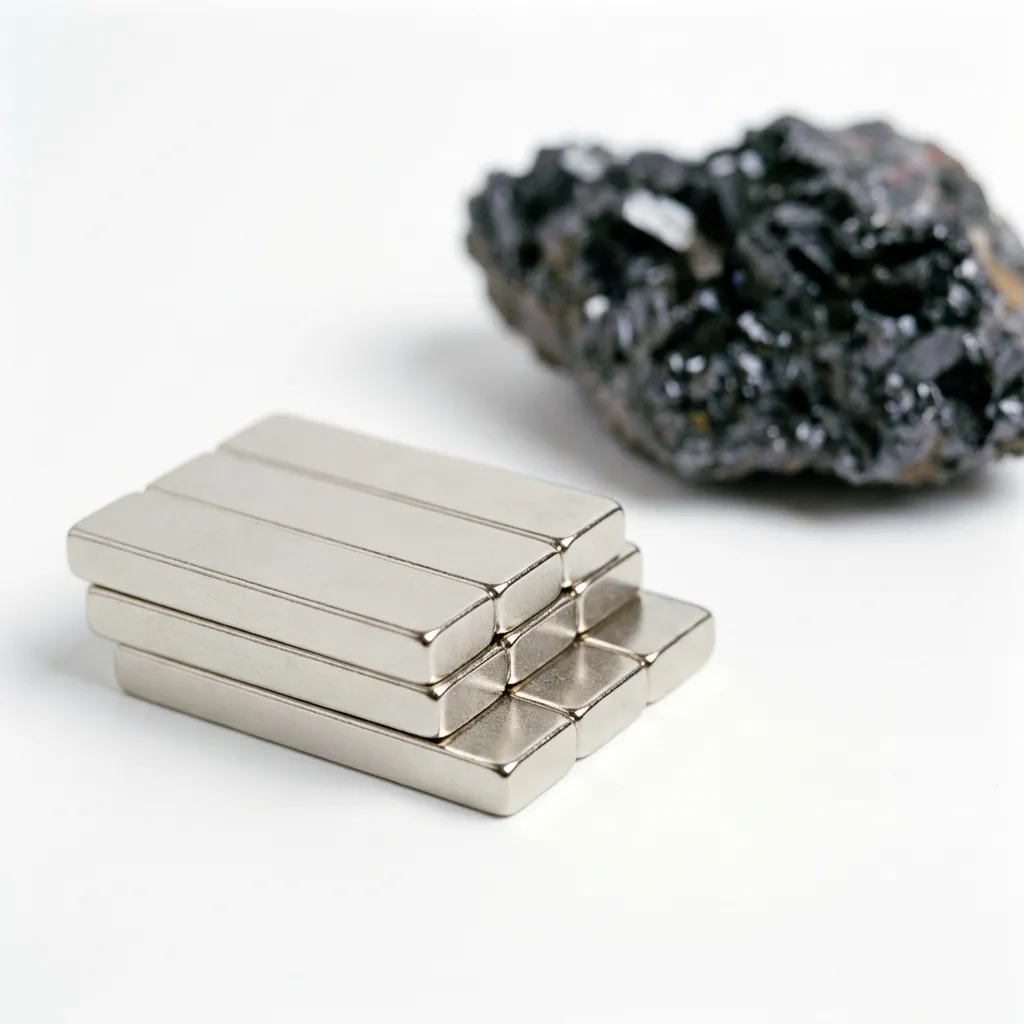
NdFeB
Neodymium Iron Boron
The strongest commercially available permanent magnet material. Used as the hard (fixed) magnet in EPMs due to its extremely high coercivity (~1000 kA/m) and energy product. Temperature-sensitive above ~150°C without special grades.
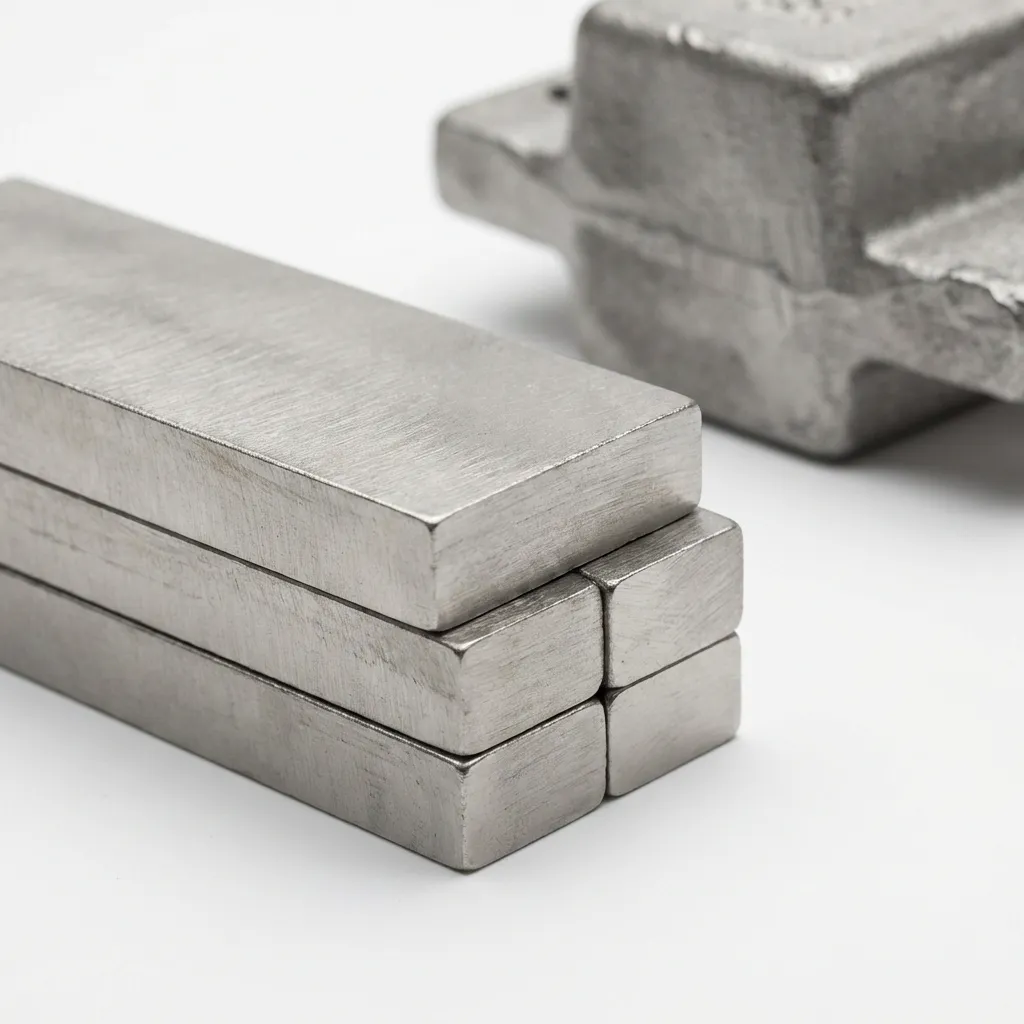
AlNiCo
Aluminum Nickel Cobalt
The switchable element. AlNiCo has moderate coercivity (~50-100 kA/m) — low enough to be reversed by the switching coil, but high enough to hold its state. Excellent temperature stability up to 500°C+. Lower energy product than NdFeB.
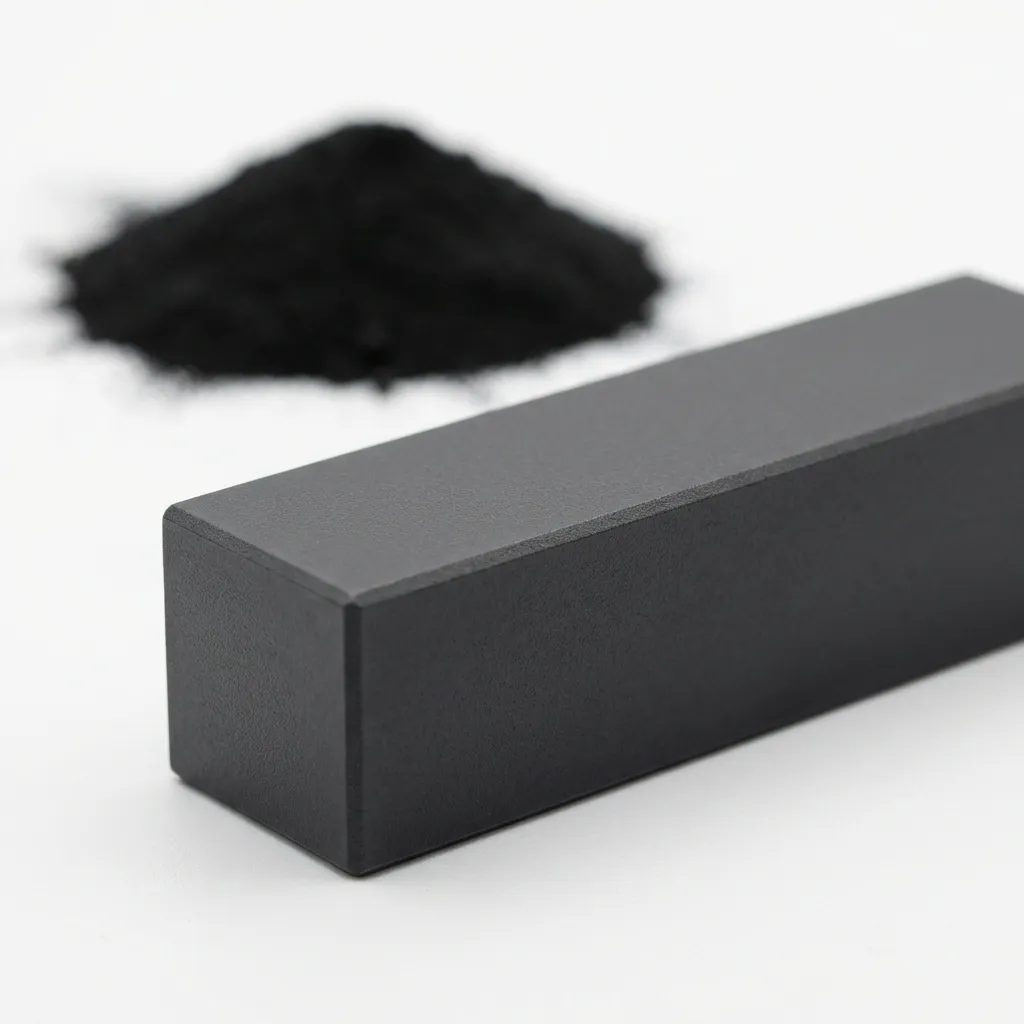
FeCrCo
Iron Chromium Cobalt
An alternative semi-hard material sometimes used in place of AlNiCo. Offers tunable coercivity through heat treatment and can be manufactured in more complex shapes. Useful for miniaturized or custom EPM geometries.
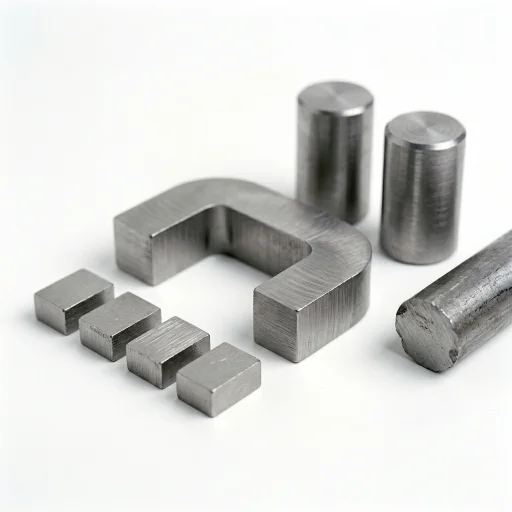
Soft Iron / Low-Carbon Steel
Pole Pieces & Field Guides
Pole pieces and return paths that direct and contain the magnetic flux. Material choice (1018 steel, pure iron) affects saturation and permeability.
Material sourcing, FEA simulation, driver electronics, and design trade-offs are covered in depth on our EPM Engineering & Design page.
Comparison
EPM vs. Electromagnet vs. Permanent Magnet
| Property | EPM | Electromagnet | Permanent Magnet |
|---|---|---|---|
| Holding power consumption | None | Continuous | None |
| Typical holding power | 0 W (bistable) | 20–200 W constant | 0 W |
| Switchable | Yes (ms pulse) | Yes | No |
| Fail-safe (holds on power loss) | Yes | No — releases | Yes |
| Heat generation during hold | Negligible | Significant | None |
| Force controllability | Full (pulse tuning) | Full (current) | Fixed |
| System complexity | Moderate | Low–Moderate | Low |
EPM complexity is real — it comes from precise coil and material arrangement, nanosecond-to-millisecond pulse timing, and optional closed-loop feedback for force verification. This is not a technology you can casually prototype. But that complexity lives in the design and electronics, not in ongoing operation.
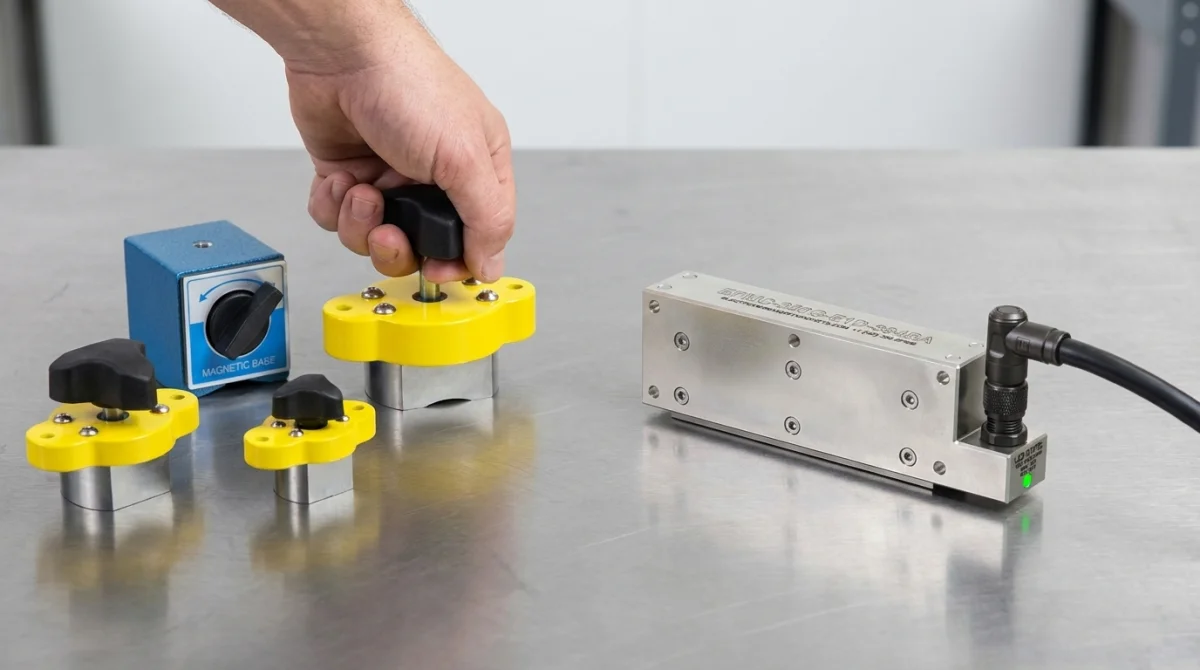
What Are Mechanically Switchable Magnets?
If you're reading this page, there's a good chance you've already discovered mechanically switchable magnets — and been impressed by their ability to turn a magnetic field on and off with zero holding power. But as you've evaluated the pneumatic, hydraulic, or motor-driven solutions needed to automate that switching, you've likely found that the added complexity of control systems, timing, rotational speed limits, and actuator weight quickly erode the advantages that drew you to switchable magnets in the first place.
Companies like Magswitch have brought consumer-available mechanically switchable magnets to market. These devices rotate a disk magnet inside a housing to either cancel or enhance the field of a static magnet, achieving impressive off-the-shelf force-to-weight ratios.
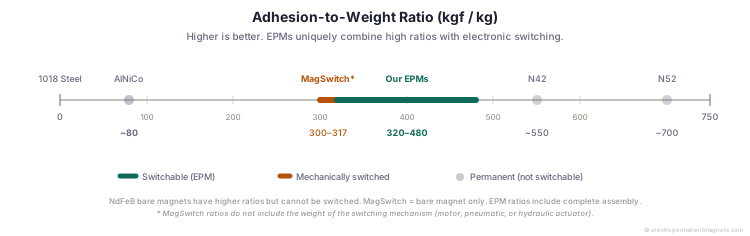
The Magswitch 95 weighs 0.136 kg and produces 43 kgf of pull force — a ratio of 317:1. The Magswitch 150 weighs 0.227 kg with 68 kgf of pull force — a ratio of 300:1. These are impressive numbers for products available off the shelf.
The Automation Problem
However, these ratios assume manual operation — a human turns a handle. When you need automated, remote, or robotic switching, the picture changes significantly. Automating a mechanical switchable magnet requires a shaft adapter, motor, motor controller, mounting hardware, and driver electronics — all of which add weight, complexity, cost, and failure modes that dramatically reduce the effective system-level force-to-weight ratio.
The switching time for mechanical rotation is also on the order of seconds, compared to milliseconds for EPMs — a critical difference for high-cycle automation, fast pick-and-place, or any application requiring rapid state changes.
Performance
Why Adhesion-to-Weight Ratio Matters
For weight-constrained platforms — UAVs, drones, CubeSats, unmanned surface vessels (USVs), and underwater robots — every gram of magnetic holding system directly trades against payload capacity, battery life, or structural budget. A climbing robot that must haul its own adhesion mechanism up a vertical steel surface needs the highest possible force per gram of magnet mass.
Robots and vehicles that climb ferrous surfaces for inspection, or manipulate ferromagnetic objects in the field, are particularly sensitive to this ratio. The difference between 300:1 and 480:1 can determine whether a design closes — whether the robot can carry its sensors and still adhere safely.
Other applications, such as automotive manufacturing and industrial workholding, still benefit from high ratios but will often trade peak performance for lower unit cost, slightly heavier but mass-producible systems, and standardized form factors. The right ratio target depends on whether your application is weight-limited or cost-limited.
Comparison
EPMs vs. Electromagnets
Electromagnets are the incumbent technology for switchable magnetic holding. They work — but they come with fundamental trade-offs that EPMs eliminate.
The Continuous Power Problem
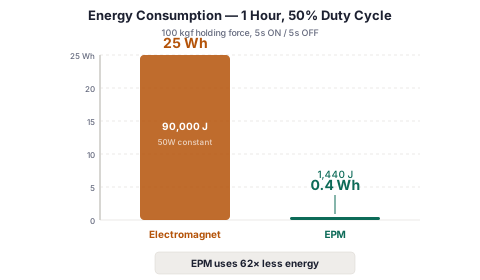
An electromagnet requires continuous current to maintain its magnetic field. This means constant power consumption, continuous heat generation, and active cooling systems for high-force applications. A 100 kgf electromagnet may draw 20-50 watts continuously — every hour of every day it's holding a load.
An EPM holding the same force draws zero watts during hold. Power is only consumed during the millisecond switching pulse. Over a year of continuous operation, the energy savings can be orders of magnitude.
The Safety Problem
When an electromagnet loses power — whether from a cable fault, breaker trip, or facility outage — it releases its load immediately. This is a fundamental safety hazard in lifting, clamping, and any application where an unexpected release could cause injury or damage.
EPMs are inherently fail-safe. The magnetic state is stored in the permanent magnets themselves, not maintained by current. Power loss has no effect on holding force. No backup batteries, no UPS systems, no emergency procedures — the load simply stays held.
Size, Weight & Heat
Electromagnets require large copper coils wound around iron cores, often with cooling fins, fans, or liquid cooling for high-duty applications. The coils add significant weight and bulk. An EPM achieving the same force is typically 60-80% smaller and lighter because it uses permanent magnet energy rather than electrical energy to generate the field.
Where Electromagnets Still Win
Electromagnets offer continuously variable force via current control and can achieve very high forces at large scale with simpler driver electronics. For applications requiring rapid, frequent force modulation where power is abundant and heat is manageable, electromagnets remain a practical choice. EPMs are the better choice when zero holding power, fail-safety, or compact size matter.
FAQ
Frequently Asked Questions
Need Help Designing an EPM System?
Our consulting team can help you select materials, design magnetic circuits, and develop switching electronics for your specific application.
Start a Conversation